번역본 하단에 영어 원문 콘텐츠가 있습니다.
The english original text is included.
관계적 아카이브: 하노이에서의 모임 현장 메모
쩡치첸 공연아카이브연구자 qiqianzeng@u.nus.edu
2026년 1월, 김달진미술자료박물관에서 한강을 건너 과천에 위치한 국립현대미술관(MMCA) 미술연구센터로 가는 버스 안에서, 나는 하노이에서 지난 한 달간 진행했던 현장 조사를 떠올렸다. 그 기간 동안 나는 거의 매일 그랩 오토바이를 타고 홍강을 건너 현지 예술가들을 만나고, 공연을 관람하며, 전시 오프닝과 모임에 참석하곤 했다. 과천의 미술연구센터와 하노이의 아 스페이스(Á Space, 2018년 설립) 모두 강 건너편에 위치하지만, 아 스페이스는 작가이자 공동 설립자인 투안 마미(Tuấn Mami, 1981- )의 자택에 자리 잡고 있었다. 이곳은 실험적인 베트남 예술가들 사이에서 모임과 따뜻한 와인, 맥주, 그리고 대화를 나누는 장소로 유명하다.
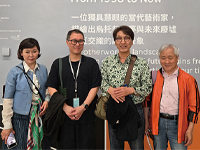
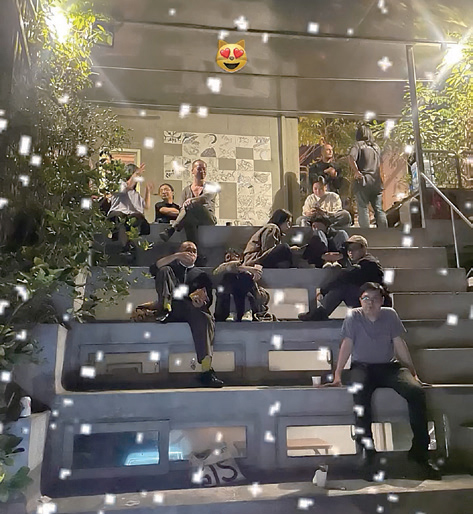 아 스페이스에서 모인 예술가들과 친구들, 2025.12.20 ⓒ Courtesy: NGUYỄN Thủy Tiên
베트남 작가 투안 마미를 만나는 건 쉽지 않았다. 1년 반 동안 온라인으로 소통한 끝에, 나는 마침내 그와 2025년 12월 6일 하노이에서 열린 어느 전시 개막식에서 만났다. 마미는 저녁 식사 겸 모임을 열어 큐레이터와 작가들을 소개해주었다. 그들은 12월 20일 아 스페이스에서 열린 크리스마스 전시 《Unlike Christmas》에 나를 초대했다. 대화 중 한 수사적 질문이 계속 마음에 걸렸다. “그러니까 큐레이터는 전시 서문 쓰려면 컴퓨터만 있으면 되고, 비디오 아티스트는 영상 편집하려면 침실만 있으면 되는 거지?” 쭈 호앙(Châu HOÀNG, 1990- ) 큐레이터가 반 농담섞인 어조로 한 말이었다. 베트남에서는 물질적으로 ‘가벼워 보이는’ 큐레이팅과 예술 작업이 종종 고된 집단적 노력을 필요로 한다는 점을 지적한 것이다. 하지만 마미처럼 외국에서 활동하는 중견 베트남 작가의 경우, 그들의 외국 프로젝트가 고국 커뮤니티에 남기는 물질적 흔적은 더 적을까? 이러한 질문을 품고, 나는 아 스페이스의 새 전시를 찾았다.
‘모임’은 이 전시와 퍼포먼스의 경계를 흐리게 하는 가장 핵심적인 요소로, 서서히 전시 자료와 사람들 간의 관계를 형성해 나갔다. 사람들은 공연 전후로 야외 계단에서 대부분의 시간을 앉아 아이디어와 의견을 교환했다. 마치 야외 극장이나 영화관에서처럼 말이다. 그곳에서 나는 예술가 응옥 나우(Ngọc Nâu, 1989- )를 만나 그녀가 자주 이곳에 오는지 물었다. “행사 있을 때마다요.” 나우는 흰 종이를 가리키며 여기 이름을 적어 등록하면 예술가 팜 민 탕(PHẠM Minh Thắng, 1996- )의 그림을 예약할 수 있으며, 오후 9시 이후에 가져갈 수 있다고 알려주었다. 나는 어리둥절했다. 전시·공연·집에서 만든 따뜻한 와인·맥주·간식·그리고 그림까지… 나는 베트남 동 한 푼도 내지 않았기 때문이다.
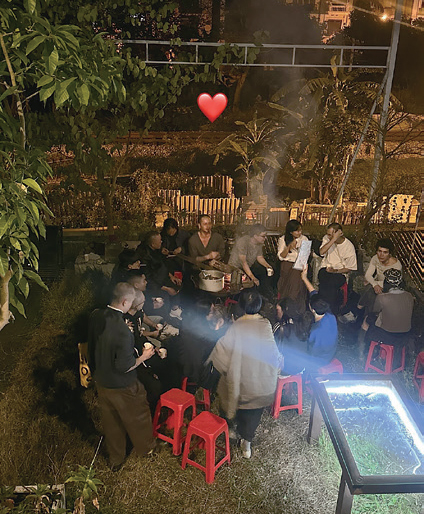 아 스페이스에서의 전시/퍼포먼스 모임 이후, 2025.12.20 ⓒ Courtesy: ĐẶNG Thùy Anh
나는 작가이자 큐레이터인 댕 투이 안(ĐẶNG Thùy Anh, 1996- )에게 이 공간과 작가들이 어떻게 버티는지 물었다.‘우리는 상황에 맞춰야 하기에 매년 아 스페이스의 구조를 바꿉니다.’ 마미에게 같은 질문을 하자, 그는 아 스페이스의 사람들이 이 공간을 지속할 수 있는 큰 힘을 준다고 설명했다. ‘그들은 또한 이 공간이 매우 가치 있고 다른 많은 공간에 기여할 수 있다고 말합니다. 그래서 여러분이 이를 위해 싸운다면, 저도 함께 싸울 것입니다.’
공연과 모임, 전시가 이어진 밤이 지나고, 나는 이 ‘일시적인’ 행사를 ‘관계적’ 아카이브를 통해 어떻게 보존할 수 있을지 고민했다: 브로셔, 그림, 초대장, 맥주 캔, 심지어 사진 같은 사물에만 의존하지 않고, 신뢰를 바탕으로 한 장기적이고 상호적인 관계를 지속하는 행위 그 자체를 아카이브로 삼는 것이다. 이 접근법은 ‘아시아 간’ 연결과 협력을 촉진함으로써 아카이브의 위치를 다각화하는 것을 목표로 한다. 이는 ‘더 나은’ 또는 ‘최고의’ 아시아 모델을 찾아내기 위한 비교를 통해서가 아니라, 아시아 내 아카이브의 다양성과 경제발전 및 예술 인프라의 불균형에 대한 배려와 존중을 통해 이루어질 것이다.
- 쩡치첸(Qiqian ZENG, 1990- )
싱가포르 국립대학교 연극 및 공연학 박사 과정 재학. 공연아카이브와 전시기획 실천의 활동과 기억이 서로 어떻게 교차하는지 연구.
A Relational Archive: Field Notes of Gatherings in Hanoi
On a shuttle bus to the MMCA (National Museum of Modern and Contemporary Art) Art Research Center in Gwacheon across the Han River, I was reminded of my month-long fieldwork in Hanoi, during which I travelled almost daily on Grab motorbikes across the Red River to visit local artists, performances, exhibition openings, and gatherings. Although both the Art Research Center in Gwacheon and Á Space (est. 2018, Hanoi) are located on the other side of the river, Á Space is situated in the home of artist and co-founder Tuấn Mami. It is celebrated by experimental Vietnamese artists for its gatherings, mulled wine, beer, and conversations.
Artists and friends gathering at Á Space, 20 December 2025. Courtesy: Nguyễn Thủy TiênÁ
Meeting the Vietnamese artist Tuấn Mami (b. 1981, Hanoi) was not easy. After one and a half years of online communication, we finally met on 6 December 2025 at an exhibition opening in Hanoi. Mami invited me to a gathering, which also served as a dinner, and introduced me to curators and artists. They invited me to their upcoming Christmas exhibition, Unlike Christmas, at Á Space on 20 December. During our conversations, one rhetorical question stayed with me: ‘So, curators only need a computer to write an exhibition preface, and video artists only need a bedroom to edit videos, right?’ Curator Châu Hoàng said it half-jokingly, commenting on how the seemingly ‘light’ curatorial and artistic practices in material terms often involve painstaking collective efforts in Vietnam.1) But for mid-career Vietnamese artists working abroad, such as Mami, do their overseas projects leave fewer material traces with the communities back home? With this question in mind, I attended the new exhibition at Á Space.
‘Gathering’ is the most essential element blurring the line between this exhibition and performance, slowly forming exhibition materials and relationships among people. People spent most of their time sitting and exchanging ideas on the outdoor staircases – like an open-air theatre or cinema – before and after the performance. There, I met artist Ngọc Nâu and asked her if she came here often. ‘Whenever they have an event,’ Nâu said.2) She then told me that I could reserve a drawing by artist Phạm Minh Thắng by registering my name on a sheet of white paper, and that I could take it home after 9 p.m. I was even more confused, as I had paid zero Vietnamese dong for the exhibition, performances, homemade mulled wine, beer, snacks, and now this drawing.
After the exhibition/performance gathering at Á Space, 20 December 2025. Courtesy: Đặng Thùy Anh.
I asked Đặng Thùy Anh, an artist and curator, how this space and its artists survive. ‘We change the structure of Á Space every year because we have to adapt to the situations.’ 3) When I asked Mami the same question, he explained that the people at Á Space give him a great deal of energy to continue the space. ‘They also say that this space is very valuable and can contribute to many others. So I think if you fight for it, I will also fight for it.’ 4)
After the night of performance, gathering, and exhibition, I contemplated how I might preserve this ‘ephemeral’ event through a ‘relational’ archive: an archive that does not merely rely on objects, such as brochures, drawings, invitation cards, cans of beer, or even photographs, but relies on the act of sustaining long-term, reciprocal relationships grounded in trust. This approach aims to multiply the locations of archives by fostering ‘Inter-Asia’ connections and collaborations 5) – not through comparisons to identify a ‘better’ or ‘best’ Asian model, but through care and respect for the diversity of archives and the unevenness of economic development and art infrastructure within Asia.
1) Châu Hoàng, conversations and correspondence with the author, 9 March 2026.
2) Qiqian Zeng, Field notes, 2 February 2026.
3) Đặng Thùy Anh, interview with the author, 24 December 2025.
4) Tuấn Mami, interview with the author, 10 December 2025.
5) ‘Inter-Asia’ here refers to critical theorist Kuan-Hsing Chen’s concept of Asia as method and sociologist Chua Beng Huat’s notion of inter-Asia referencing. They have both contributed to the decentralisation of Euro-American epistemologies by promoting the examination of Asian societies through cross-referencing within the region.
Acknowledgements
I would like to thank Mr. Kim Daljin, Kim Junghyun, Ahn Hyorye, and Kim Youngna at the Kim Daljin Art Archives and Museum, as well as the artists and curators I met at Á Space, Hanoi, during December 2025 and January 2026.
Qiqian Zeng qiqianzeng@u.nus.edu
Qiqian Zeng is a PhD candidate in Theatre and Performance Studies at the National University of Singapore. Her research examines the intersections of performance archives, curatorial practice, and memory.